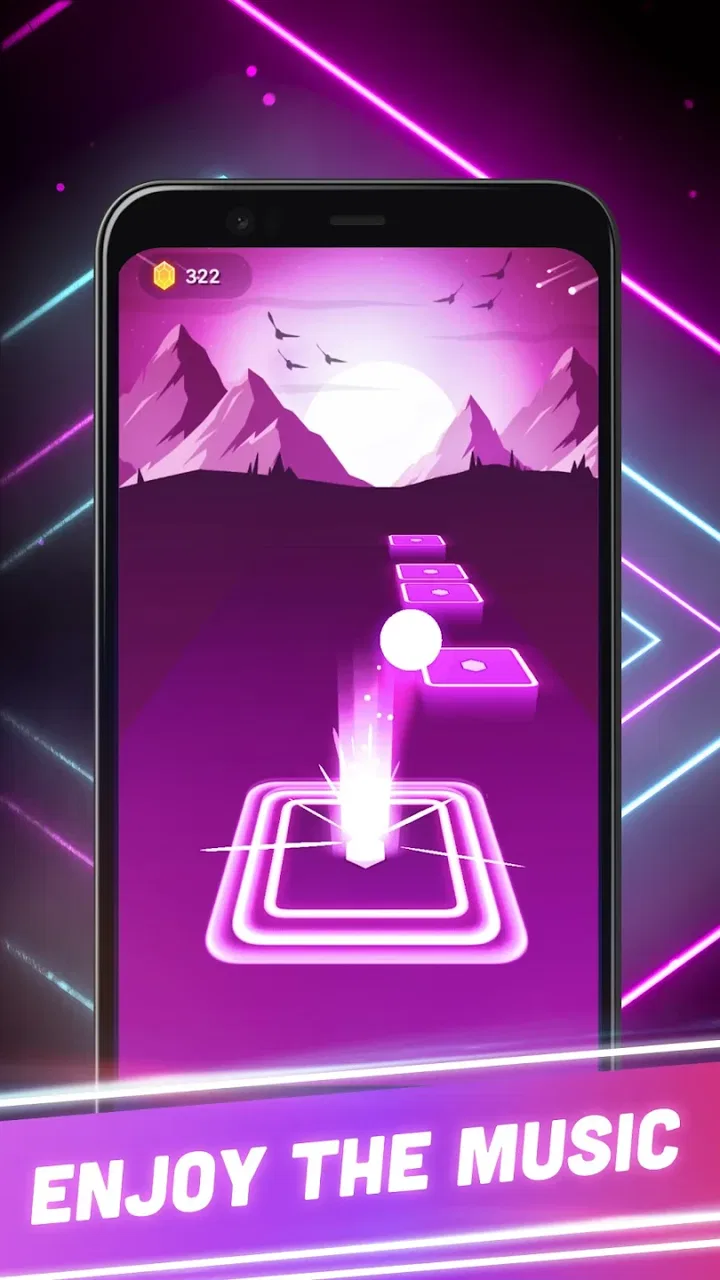
Beat Tiles 3D: Music Game
- 4.1
- Rating
- 10.00M
- Installs
- Free
- Price

 Analysis by App-foxy
Beat Tiles 3D is the kind of music game I open when I want a quick burst of rhythm rather than a deep, carefully structured campaign. Its basic idea is immediately readable: move through tile-based stages while popular songs provide the beat. After spending time with it, my overall view is positive but specific. It is easy to start, satisfying when my timing settles into the music, and well suited to short sessions. It is less convincing as a serious rhythm challenge or as a replacement for games built around precise note charts and long-term mastery.
That distinction matters. The store summary makes the experience sound like a simple jump through tiles, and that is broadly accurate, but the appeal is not only the movement. The real hook is the connection between visual progress and musical timing. When the next tile arrives in a predictable rhythm, I stop thinking about individual taps and begin reacting to the song as a pattern. That small shift is what keeps a short attempt from feeling like an ordinary reflex test.
How the music and movement work together
The first few moments are deliberately approachable. I do not need to study a complicated interface before playing, and the central action can be understood almost immediately. The screen presents a path of tiles, while the song gives me an audible cue for when to make the next move. This makes the game friendly to newcomers who may not normally play rhythm titles.
You May Also Like

 Blood Strike: 2.5 Anniversary
Blood Strike’s Loadouts Turn Every Drop Into a Tactical Gamble
A close look at Blood Strike’s custom loadouts: how fast access to signature weapons reshapes its battle royale rhythm, rewards preparation, and narrows the gap between fights.

 Pandora - Music & Podcasts
Pandora’s Music Is Easy to Start, but Harder to Recover
Pandora’s strength is its low-effort path from a seed to a station. Its weak spot is how much confidence it asks you to place in connection, setup, and quiet recovery.

 8 Ball Pool
 Is Built on Rivalries, Rematches, and Routine
A close look at the rivalries, rematches, shared routines, and unanswered safety questions that turn a quick pool match into a persistent mobile community.

 Samsung Music
’s Quiet Strength Is Playing What You Already Own
Its reach comes less from spectacle than from dependable access to a personal library. That simplicity is both the app’s strongest retention engine and its ceiling.

 AccuWeather: Weather Radar
AccuWeather Review: A Quick, Clear Forecast for Everyday Decisions
For everyday plans, the best forecast is the one you can understand quickly. AccuWeather makes rain timing, radar, and local conditions easy to act on, with a few trade-offs.

 Hill Climb Racing
Why Hill Climb Racing Still Turns Crashes Into One More Run
A tiny car, a bumpy hill and one more upgrade: Hill Climb Racing keeps resurfacing because its simple chaos makes every near-miss feel personal.
More From Our News Desk
View All News


What I enjoy most is the way mistakes become easier to diagnose than in many casual music games. If I miss repeatedly, the problem is usually visible in my own play: I am moving too early, reacting to the visual tile instead of the beat, or losing concentration when the pattern changes. That makes improvement feel practical. I can focus on listening first and watching second, rather than simply tapping faster whenever a stage becomes difficult.
There is also a useful difference between playing with sound and playing silently. With audio, the game becomes a timing exercise. Without it, the visual movement still offers something to follow, but the experience loses much of its personality and becomes more dependent on prediction. I would strongly recommend headphones in a quiet place, not because the game demands an elaborate setup, but because the music is the part that turns the tile path into a rhythm challenge.
One of my more effective habits was to avoid staring at the character or the current tile. Looking slightly ahead helped me read the route while using the beat to decide when to move. This is a small adjustment, but it reduces the panicked corrections that happen when I wait until the last possible moment. It also makes the game feel less random, even when a sequence initially appears fast.
The music-game format gives the experience a light, energetic mood. I can play for a few minutes while waiting for an appointment, then stop without feeling that I have abandoned a complicated story or a long mission. That flexibility is one of its strongest qualities. It works as a quick distraction, but it can also encourage repeated attempts when I know a failed run was caused by my timing rather than by an impossible section.
Why the simple format works
Many mobile rhythm games overwhelm the player with multiple lanes, note types, modifiers, and menus. This one takes a narrower route. Its tile-based presentation keeps the first interaction clear, and that clarity is valuable on a phone screen. I can understand what the game wants from me even when I am playing with one hand or returning after a break.
The trade-off is that the simplicity limits how much depth I can find. Players who enjoy building elaborate combos, choosing difficulty modifiers, or studying dense note patterns may eventually want more control. Here, the pleasure comes from repeating the central loop and becoming more consistent, not from designing a personalized challenge.
That makes it particularly suitable for casual players who like music but do not want to learn a traditional rhythm-game interface. It is also a reasonable introduction for someone who has never tried this category. The game does not require me to understand specialist terminology or memorize a complicated control scheme before I can have a useful first session.
Everyday play is where it makes the most sense
A realistic example is a short commute or a break between tasks. I can play a few attempts, put the phone away, and return later without needing to remember a story objective. If I am tired, I can still enjoy the music and the movement at a relaxed pace. If I am more focused, I can use the same brief session to work on cleaner timing.
It also works well as a small social activity, although I would describe it as a compare-and-try game rather than a full multiplayer experience. Handing the phone to a friend and asking them to beat a difficult run creates an immediate challenge without requiring a long explanation. The appeal comes from seeing whether someone else can read the rhythm more naturally, not from a large competitive system.
Another useful approach is to play it as a listening exercise. Instead of chasing completion immediately, I can replay a section and pay attention to how the song marks the next movement. This is more rewarding than treating every failure as a reason to rush. The game becomes a test of consistency, where a calmer response is often more effective than a faster one.
The main strengths, and the friction that keeps it casual
The strongest evidence in its favor is accessibility. I can understand the basic objective quickly, and the combination of recognizable music energy with simple movement creates an inviting first impression. AppRover has kept the central idea focused enough that the game does not feel like a menu-heavy music app disguised as a game.
Its free entry point also lowers the risk of trying it. The game is free to download, while optional purchases range from $0.99 to $39.99 per item. That range is worth keeping in mind before spending time with it. I would begin with the free experience and decide whether the available music and progression justify any purchase, rather than assuming that paying is necessary to enjoy the basic concept.
The audience size suggests that the format has broad appeal: it has passed 10 million installs, carries an average rating of 4.1 from around 37 thousand ratings, and has about 580 written reviews. I do not treat those figures as proof that every player will enjoy it, but they do fit my impression that this is designed as an approachable mobile game rather than a specialist rhythm simulator.
The meaningful weakness is repetition. Once I understand the movement pattern, the basic loop can start to feel familiar, especially if I am looking for a large variety of mechanics. The music helps maintain energy, but it cannot completely solve the problem of doing essentially the same kind of action across many sessions. Players who need constant novelty may lose interest sooner than casual users.
I also found that the game is more dependent on my attention than its relaxed presentation suggests. A brief lapse can break a run, particularly when I am playing in a noisy environment or trying to divide my focus between the screen and another task. That is not necessarily a flaw in a rhythm game, but it means this is not ideal background entertainment. If I want something I can play almost automatically, a simple puzzle or idle game may be a better fit.
Another limitation is precision. The experience can feel satisfying when my timing and the visual path agree, but players who expect the exact responsiveness of a dedicated console or arcade rhythm title may find it less demanding and less exact. I would not choose it to replace a game built around advanced chart reading. Its strength is the quick, musical sensation, not competitive technical depth.
Sound conditions make a noticeable difference. In a quiet room, I can use the song as a reliable guide. In public, I may rely more heavily on visual cues, which makes the same stage feel less natural. This is one reason I see it as a better headphone game than a silent waiting-room game. The visual design keeps it playable, but the music is what gives the actions their rhythm.
Who should try it, and who should skip it
I would recommend it to someone who wants a free music game for short sessions, especially if that person likes quick retries and straightforward controls. It is a good choice for casual players, younger teens who meet its Teen content rating, and anyone curious about rhythm games but hesitant to start with a more demanding title.
It is also a good match for players who enjoy improving through repetition. The best moments come when I recognize a pattern, stop overcorrecting, and complete a section with smoother timing than before. That kind of modest progress can be surprisingly satisfying, even without a complex upgrade system or a long narrative.
I would be more cautious about recommending it to expert rhythm-game fans. If your priority is detailed note mapping, strict competitive scoring, extensive customization, or a deep progression structure, the usual alternatives in the category are likely to serve you better. A lane-based rhythm game can offer more precision and more ways to practice specific techniques, while a music runner may provide more constant movement variety. This title sits between those options: more musical than a basic reflex game, but less demanding than a dedicated rhythm platform.
Parents and younger players should also notice the Teen rating before installing it. That does not automatically make the game unsuitable, but it is a reminder to check whether its presentation and purchase options fit the intended player. Since optional items can cost as much as $39.99 each, I would also review purchase settings before handing the device to a child.
Compatibility is relatively broad for an older phone: the game requires Android 5.1 or later. That helps people with devices that are not running the newest operating system, although actual comfort will still depend on the phone's screen, sound output, and general responsiveness. For the best experience, I would close distracting apps, use stable audio, and avoid playing while the device is struggling with other tasks.
Small habits that improve the experience
My first practical tip is to calibrate my attention before trying to chase a high result. I listen to the opening beats, identify the recurring pulse, and then move with that pulse instead of reacting to every visual change. This reduces frantic inputs and makes difficult sequences feel more manageable.
Second, I prefer short practice bursts over one long session. After several failed attempts, my reactions become tense and I start moving early. Taking a break and returning later often produces a cleaner run than forcing another dozen retries. The game is well suited to this approach because its sessions do not require a large time commitment.
Third, I treat the screen as a guide rather than the only source of information. Looking ahead along the path gives me more time to prepare, while listening tells me when to commit. This two-part method is more reliable than watching the nearest tile and making a last-second decision.
Finally, I would not spend money simply because a song or stage feels difficult. The challenge is often a timing issue that can improve through repetition. I would first test whether the free content keeps me interested, then consider an optional purchase only if it adds something I genuinely expect to use repeatedly. That approach keeps the free-to-play structure from turning a casual game into an impulse purchase.
My verdict after playing
Beat Tiles 3D is best understood as a friendly, music-led reflex game, not a full rhythm-game training ground. Its direct controls, short-session design, and beat-focused movement make it easy to recommend to casual players who want something energetic without a steep learning curve. I enjoyed the moments when the tile path and song aligned, especially when I improved by listening more carefully instead of simply reacting faster.
At the same time, its simplicity creates a clear ceiling. Repetition can set in, the experience is less satisfying without sound, and serious rhythm fans may find the challenge too limited compared with more specialized alternatives. The optional purchase range also deserves sensible caution, particularly on a shared device.
AppRover's current version is 2.09.01, and the game remains a practical pick for anyone looking for a free music game that can fill a few spare minutes. I would install it for quick attempts, headphones, and casual improvement. I would skip it if I wanted a deep campaign, precise competitive scoring, or a game that stays interesting without relying on repeated tile-and-song runs.
In short, this is a pleasant choice when the goal is immediate musical interaction. It does not need to be more complicated than that, but it should be judged on those terms. For the right player, the focused design is its charm; for everyone else, the same focus may be the reason to look elsewhere.
FAQs for Beat Tiles 3D: Music Game
01What is Beat Tiles 3D: Music Game about?
Beat Tiles 3D: Music Game is an engaging rhythm-based game where players navigate through a dynamic 3D environment by tapping tiles in sync with the beat of the music. The game offers a variety of tracks across different genres, challenging players' timing and reflexes while providing an immersive musical experience.
02Is Beat Tiles 3D: Music Game free to play?
Yes, Beat Tiles 3D: Music Game is free to download and play on both Android and iOS platforms. However, the game may offer in-app purchases for additional features, tracks, or to remove ads, enhancing the overall gameplay experience for those who choose to invest.
03What are the system requirements for Beat Tiles 3D?
For Android devices, Beat Tiles 3D requires Android 5.0 and up, while iOS devices need iOS 10.0 or later. The game is optimized for both smartphones and tablets, ensuring smooth performance across a range of devices. It’s recommended to have a stable internet connection for accessing online features.
04Can I play Beat Tiles 3D offline?
Yes, Beat Tiles 3D: Music Game offers offline gameplay, allowing players to enjoy their favorite tracks without an internet connection. However, certain features like leaderboard updates and downloading new songs may require a connection. Offline mode is perfect for gaming on-the-go without worry.
05Is Beat Tiles 3D suitable for all ages?
Beat Tiles 3D is designed to be family-friendly and is suitable for players of all ages. The game’s intuitive controls and engaging music make it accessible to younger audiences, while the increasing levels of difficulty provide a challenge for older players. Parental guidance is always recommended for in-app purchases.
Pros
- Engaging and vibrant 3D visuals.
- Wide variety of popular tracks.
- Smooth and responsive controls.
- Frequent updates with new content.
- Easy to learn
- hard to master.
Cons
- Contains in-app purchases.
- Ads can be intrusive at times.
- Limited offline functionality.
- Occasional lag on older devices.
- Song selection could be broader.

Beat Tiles 3D: Music Game
Gallery